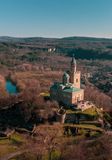
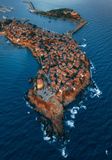
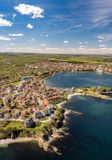
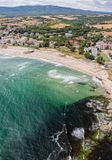
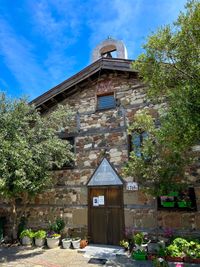
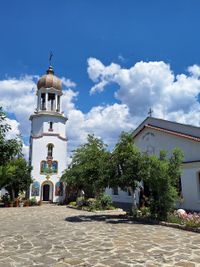
The Church of the Holy Transfiguration of the Lord (Sveto Preobrazhenie Gospodne) is the oldest surviving building in Pomorie and the oldest continuously active church on the Bulgarian Black Sea coast, located in the easternmost part of the Old Town peninsula of Pomorie, in Pomorie Municipality, Burgas Region. The church is a national monument of culture and stands within the boundaries of the architectural reserve of the Old Pomorie Houses — indeed it is the oldest structure within the reserve itself. It was built in 1763–1764 on the site of an earlier temple that had existed from the 9th century and was destroyed in 1760, and was completed and consecrated on 6 August 1765 — the feast day of the Transfiguration, after which it is named. During the devastating fire of 30 July 1906 that destroyed three of the four Orthodox churches of Pomorie, the Church of the Holy Transfiguration alone survived unscathed. In 1987 a major restoration was carried out; the balcony that had served as a gallery for the choir and for women's prayer was converted into a museum section, today housing unique ecclesiastical objects and artefacts connected to the history of Pomorie. By a decision of the Council of Ministers in September 2019, the church was transferred entirely and free of charge to Pomorie Municipality.The building is a three-nave, massive rectangular structure entirely built of stone with wooden tie-beams (santratsi) and a boarded ceiling, in the post-Byzantine architectural style, with a double-pitched roof and large stone flags covering the floor. Unusually for Bulgarian Orthodox churches, it has no altar apse — a rare feature in the construction of temples on Bulgarian territory, as the director of the Pomorie Historical Museum has noted. The church has no wall frescoes. Its outstanding artistic significance rests on the carved-wood iconostasis, executed using diverse floral motifs and dating from the time of the church's construction. It houses 17 large icons in the royal (tsar's) tier, painted by different icon painters in the 17th–18th centuries, some from the 16th century; the second apostolic tier contains 33 smaller icons. The oldest icon in the collection dates from the end of the 15th or beginning of the 16th century. Beneath the royal icon of Jesus Christ Pantocrator, a small holy spring (ayazmo) of crystal-clear water rises — known to the local faithful as "the Tears of Christ." During recent archaeological excavations in the church's courtyard, marble architectural elements from the 6th century (Early Byzantine period) — a capital and a stone block — were discovered, brought from Paleokastro (today the St George quarter of Pomorie), testifying to the long sacred history of this corner of the ancient town.