

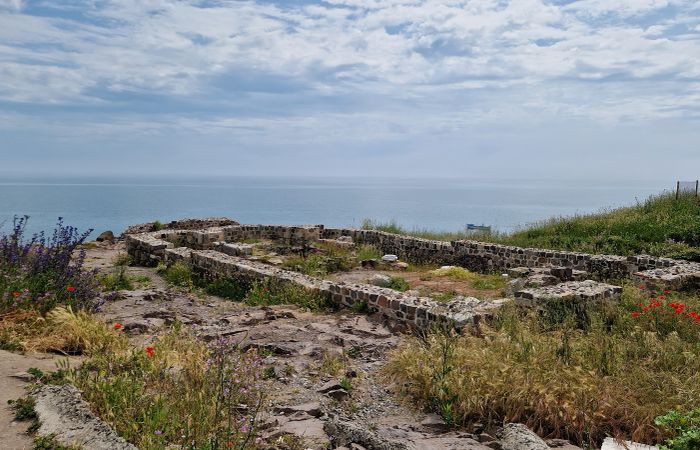
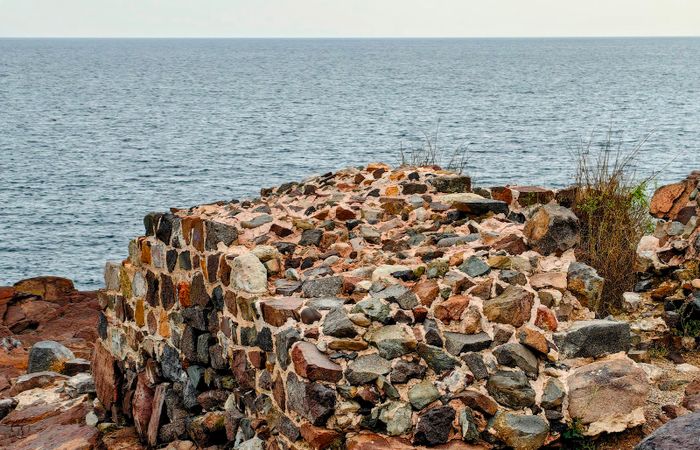

Medieval monastery "St. Apostles"
The Sozopol Monastery of the Holy Apostles (also known by its full medieval dedication as "Holy Apostles and 20,000 Martyrs") is a medieval monastic complex located on Cape Skamni — the northeasternmost and most dominant point of the Sozopol Peninsula — in Sozopol Municipality, Burgas Region. The ruins of the monastery are today one of the most archaeologically significant and historically layered sites in the Old Town, and the site was excavated in the period 2011–2015. Its existence as a city monastery on Cape Skamni had been known only from documents, and the decisive impetus for the excavations came when archaeologists encountered a speech from the 1857 opening of the Greek school built on the same spot, in which its director declared: "And here, where in antiquity our monastery of the Holy Apostles once shed its light, our school shall shed its light." The monastery was uncovered in early 2011 during the clearing of fortress structures that were already visible at the surface.The site is one of the most remarkable examples of sacred continuity in Sozopol, with layers of human use spanning more than two millennia. Archaeological excavations confirmed that Cape Skamni was already considered a sacred place by the inhabitants of ancient Apollonia — as early as the 6th century BC the volcanic rocks of the cape, riddled with fissures and bearing traces of artificial cutting, served as a sanctuary of Demeter and Persephone (a Thesmophorion), in which ritual activities were performed exclusively by women and which remained in use until the 3rd century BC. Figurines of Demeter and Persephone and special vessels used in the cult of Demeter were found at the site. Remains of late antique and medieval fortress walls with a polygonal tower were also uncovered.At the beginning of the 11th century AD a small chapel (martyrium) was built on the cape, followed in the 12th century by a three-nave basilica, around which a large monastery complex developed and functioned until the early 15th century. The main monastery church — built around 1335 AD by Anastasios Palaiologos, uncle of Byzantine Emperor John V Palaiologos (1341–1391) and a relative of Bulgarian Tsar Mikhail Shishman (1323–1330) — was described by Bulgarian archaeologist Prof Bozhidar Dimitrov as the largest and most beautiful church on the entire Bulgarian Black Sea coast of its time. The church space is organised into an outer and inner narthex, a three-nave naos with colonnades separating the naves, and a three-apse altar. In the northern nave a cistern cut into the rock was discovered, predating the church. Secondary architectural elements from earlier religious buildings were incorporated into the church's construction, and fragments of the original polychrome marble floor paving survive in places. A large Christian necropolis containing more than 180 burials was also excavated around the complex, dating from the 13th to the 19th century. More than 55 medieval coins — two silver and the remainder bronze, including coins from the Latin coinage of the 13th century after the Fourth Crusade — were found in the grave of a young woman, an unusual find for Christian funerary practice. In the period from the 16th to the 18th century a small Ottoman garrison was stationed on the site, after which, during the Bulgarian National Revival, Christian tradition was restored with the construction of a small chapel and the building of the first secular school in Sozopol on the same ground.


